
Irregular periods are rarely random. Discover 7 hormonal root causes and the functional medicine approach to natural irregular periods treatment that restores balance.
If your periods have become unpredictable, heavier, lighter, longer, shorter, or have stopped showing up on any kind of schedule, you are not imagining the problem and you are not alone. Many women are told that irregular periods are simply something to live with, that birth control will mask the cycle, or that the bloodwork came back normal so there is nothing more to investigate. The frustration of being passed from one specialist to another while still tracking a cycle that does not behave is one of the most common reasons patients come to a functional medicine practice.
This guide walks through what irregular periods actually are, why conventional workups often miss the underlying drivers, and the seven hormonal root causes that show up most often in women who do not have an easy diagnosis. We will cover what comprehensive testing should look at, what realistic recovery looks like, and how an integrative approach can help bring a cycle back into a healthy rhythm. At Integrative Wellness Centers, we work with women whose lab work is technically normal but who know something is off, and the goal of this article is to give you the same clarity our patients receive in their first consultation.
If you have been searching for answers about irregular periods and feel like conventional approaches have not addressed the root cause, you are not alone. Integrative Wellness Centers works with patients in-person across Michigan and via Zoom in most US states to identify what is actually driving these symptoms. You can schedule a new patient consultation to discuss your specific situation with our care team.
A regular menstrual cycle is one of the clearest monthly signals the female body gives about its overall health. The cycle depends on a coordinated conversation between the brain, the thyroid, the adrenal glands, the ovaries, and the gut. When that conversation gets disrupted, the cycle is usually the first thing to show it. That is why irregular periods are often the earliest warning sign of something larger going on, not a stand-alone inconvenience.
Long-term consequences of unaddressed irregular cycles can include fertility challenges, an increased risk of metabolic conditions like type 2 diabetes, bone density concerns when estrogen runs low for too long, and a higher likelihood of endometrial issues when estrogen runs unopposed by progesterone. Population-based research has linked persistent menstrual irregularities to a significantly higher long-term risk of insulin resistance and cardiometabolic disease, which is why ignoring the pattern can be costly.
Beyond the physiology, irregular periods take a real toll on quality of life. Patients describe planning vacations around an unpredictable cycle, missing work because of breakthrough bleeding, struggling with mood swings that track loosely to hormones they cannot pin down, and the exhausting mental load of never quite knowing what their body will do next. Treating the root cause does not just regulate the cycle. It often resolves the fatigue, the anxiety, the weight changes, and the skin symptoms that have come along for the ride.
A normal menstrual cycle, according to Cleveland Clinic, typically occurs every 21 to 35 days, lasts four to seven days, and produces a consistent amount of bleeding cycle to cycle. Anything that consistently falls outside that range or varies dramatically from month to month is considered irregular. Some variation is normal, especially in the years after a first period and again during the years leading into menopause, but a pattern of unpredictability in your prime reproductive years is almost always a sign that something deserves attention.
Common signs that your periods are irregular include:
Many women normalize one or two of these patterns for years before recognizing them as something to investigate. A cycle does not need to fit a textbook 28 day pattern to be healthy, but it should be predictable, manageable, and not interfere with daily life. When it is not, the cycle is asking a question that deserves a thorough answer rather than a prescription for hormonal birth control that simply silences the signal.
Most women who walk into a primary care office or gynecologist with irregular periods receive one of three responses: a pelvic exam and an ultrasound to rule out structural issues, a basic blood panel that checks TSH and a few sex hormones at one point in the cycle, or a recommendation to start hormonal birth control to regulate the bleeding pattern. Each of these has a place, but none of them looks deeply at why the cycle is irregular in the first place.
One of the biggest gaps lies in lab interpretation. Standard reference ranges for thyroid markers, for example, are wide enough that a woman can sit at the very edge of the range, feel exhausted, gain weight, and have classic symptoms of hypothyroidism while still being told her labs are normal. A peer-reviewed analysis of women with menstrual irregularities found a strong correlation between subclinical thyroid dysfunction and irregular cycles, particularly when thyroid antibodies were elevated. Functional medicine uses tighter optimal ranges and looks at the full thyroid panel, including Free T3, Reverse T3, and thyroid antibodies, rather than relying on TSH alone.
The second gap is symptom-focused treatment. Hormonal birth control does not regulate a cycle. It overrides it. The bleeding that occurs on the pill is withdrawal bleeding caused by the placebo week, not a true ovulatory period. When a woman stops the pill years later, the original root cause is still present and often more entrenched. The cycle that returns is usually the same irregular cycle she had before the pill, which is why so many women feel blindsided when they come off contraception to try for a baby.
The third gap is timing. A single hormone draw on day three of a cycle cannot tell you what your progesterone looks like in the second half of the cycle, when ovulation problems usually show up. A functional approach uses cycle-mapped urine hormone testing, looks at adrenal and metabolic markers in the same workup, and considers nutrient status, gut health, and stress patterns as part of the same picture. The result is a far more accurate map of what is actually disrupting the cycle.
The table below compares what a typical standard workup looks at versus what a thorough functional workup includes.
In our experience working with patients over the years, the same handful of root causes show up again and again in women who have been told their cycles are simply unpredictable. They almost never occur in isolation. A typical patient is usually carrying three or four of these at once, which is why a one-medication fix rarely works. Below are the seven most common drivers we see, and they connect directly to the wider picture of hormonal imbalance that functional medicine is designed to address.
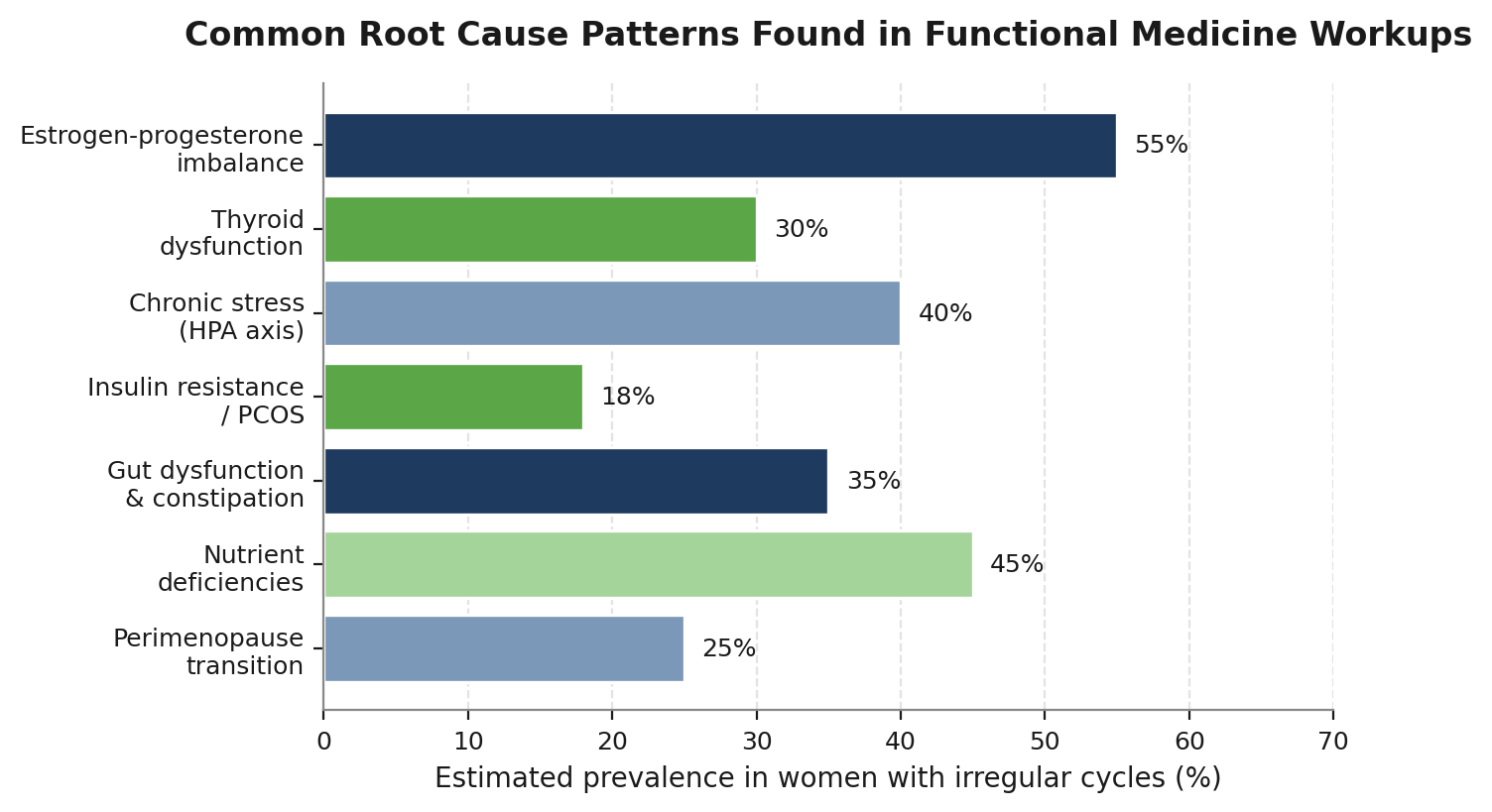
In a healthy cycle, estrogen rises in the first half and progesterone rises after ovulation in the second half. When ovulation does not happen reliably, or when estrogen is not cleared properly through the liver and gut, the ratio between the two tips toward unopposed estrogen. This is what most people mean by estrogen dominance, and it shows up as heavy bleeding, painful periods, breast tenderness, mood swings, and shorter or skipped cycles. The fix is rarely about taking estrogen out. It is usually about supporting ovulation, improving estrogen clearance through the liver and gut, and rebuilding adequate progesterone in the luteal phase.
The thyroid sets the pace for nearly every cell in the body, including the ovaries. When the thyroid is underactive, even slightly, periods can become heavy, longer, and farther apart. When it is overactive, periods can become lighter and shorter. Hashimoto’s, the autoimmune form of hypothyroidism, is one of the most under-diagnosed causes of irregular cycles because it can be present for years with normal TSH but elevated thyroid antibodies. A full thyroid panel that includes Free T3, Free T4, Reverse T3, and antibodies is the only way to catch it early. Treating the thyroid properly, including the autoimmune component, often regulates the cycle without anything else being added.
Cortisol, the body’s main stress hormone, is made from the same building block as progesterone. When the demand for cortisol is chronically high, the body prioritizes survival over reproduction and progesterone falls. The brain also responds to chronic stress by quieting the signals that drive ovulation, which is why women under prolonged stress often notice their cycles getting longer, lighter, or disappearing entirely. This is not in your head. It is a well documented neuroendocrine response involving the HPA axis. Supporting the nervous system with sleep, blood sugar stability, breathwork, and adrenal-focused nutrition is often a foundational step in restoring a regular cycle.
Blood sugar and reproductive hormones are deeply intertwined. When insulin is chronically elevated, it stimulates the ovaries to produce excess androgens like testosterone, which can suppress ovulation and produce the classic pattern of polycystic ovary syndrome (PCOS), a leading cause of irregular cycles. Even women without a formal PCOS diagnosis can have subclinical insulin resistance that shortens or lengthens their cycle. Fasting insulin, A1C, and HOMA-IR are usually more revealing than fasting glucose alone. Stabilizing blood sugar through balanced meals, protein at breakfast, and strategic movement is one of the most powerful and most overlooked interventions for cycle regularity.
This is the cause that most patients are surprised by, but it is a major piece of the puzzle. After the liver packages estrogen for elimination, the estrogen travels through the bile into the gut where it is supposed to be excreted in stool. If you are constipated, that estrogen sits longer than it should, gets deconjugated by certain gut bacteria, and recirculates back into the bloodstream. Research on the estrobolome, the collection of gut microbes that metabolize estrogen, has shown that gut dysbiosis directly affects circulating estrogen levels. This is why women with chronic constipation, SIBO, IBS, or long histories of antibiotic use so often present with heavy, painful, or irregular periods. Addressing the gut is not optional in any complete hormone protocol. Daily bowel movements, fiber diversity, and balanced gut bacteria are essential for hormone clearance.
The ovaries and the thyroid have some of the highest nutrient demands in the body. Low iron from heavy bleeding or poor absorption can drive fatigue and worsen the cycle. Low magnesium, zinc, and B6 affect ovulation and progesterone production. Iodine and selenium are critical for thyroid hormone synthesis and conversion. Vitamin D acts as a hormone in its own right and is involved in cycle regulation. When these are depleted, no amount of stress management or hormone support will fully restore a cycle. This is why a comprehensive workup always includes nutrient testing rather than assuming a multivitamin will cover it.
Perimenopause can begin in the late thirties and last for a decade. During this window, ovulation becomes less reliable, progesterone drops first, and estrogen begins to swing more dramatically. Cycles often become shorter, then longer, then unpredictable. Many women are told they are too young for perimenopause when they are squarely in it. The functional medicine approach in this stage is not to override the transition but to support the body through it with targeted nutrition, adrenal support, blood sugar stabilization, and, where appropriate, bioidentical hormone support. The other six root causes on this list usually become more pronounced during perimenopause, which is why women in this stage feel everything getting worse at once.
Functional medicine treats the cycle as a system rather than a symptom. The goal is to map all of the contributing factors, address them in the right order, and let the body do what it was designed to do once the obstacles are out of the way. Most patients with irregular periods see meaningful change within the first few months of a structured plan.
The starting point is always thorough testing. We use advanced lab testing to look at the full hormone picture, not just a single point in time. Typical testing includes a complete thyroid panel with antibodies, cycle-mapped urinary hormone metabolites that show how the body is making and clearing estrogen and progesterone, fasting insulin and metabolic markers, a diurnal cortisol pattern, micronutrient analysis, and gut health testing where indicated. This level of testing is what distinguishes a root cause workup from a symptom-driven prescription and is what allows the care team to build a treatment plan that addresses the actual drivers of your irregular cycle.
No two patients with irregular periods have the same root cause profile. One woman might have estrogen dominance driven by gut dysbiosis, low fiber intake, and high-stress patterns. Another might have insulin resistance, low vitamin D, and a hidden thyroid antibody pattern. A third might be early in perimenopause with low progesterone and chronic poor sleep. Each of these requires a different plan. Effective treatment is sequenced, meaning the most foundational issues are addressed first so that downstream interventions have something to build on. This is why protocols pulled from social media usually disappoint. The protocol is rarely the problem. The sequence is.
Targeted nutrition is the engine that drives most hormone recovery. That usually means adequate protein at every meal, fiber from a wide variety of plants to support estrogen clearance and daily bowel movements, blood sugar stable meals, and reducing intake of inflammatory seed oils, refined sugar, and alcohol. Sleep, stress management, strength training, and minimizing endocrine-disrupting chemicals at home are layered on top. The plan is then monitored with follow-up labs and cycle tracking to confirm the changes are working, with adjustments made as the body responds.
Understanding the root cause of irregular periods starts with the right testing and a care team that takes the time to listen. Integrative Wellness Centers offers in-person care across Michigan and Zoom consultations for patients in most US states. If you are ready to stop guessing and start getting answers, you can book a consultation with our functional medicine team.
Honest expectations matter. The body did not arrive at an irregular cycle overnight, and it does not return to balance overnight either. Most patients on a structured 4 to 7 month care plan see meaningful change in stages. The first 30 to 60 days often bring better energy, better sleep, and more stable mood, even before the cycle itself looks different. By month three or four, cycles typically begin to land in a more predictable window. By month five through seven, many patients are running consistent ovulatory cycles for the first time in years.
Some patients see results faster, especially when the primary driver is straightforward, like an easy-to-treat thyroid antibody pattern or a clear nutrient deficiency. Others take longer, particularly when long-term contraception has been involved, when there is autoimmune activity, or when several root causes are stacked. Perimenopause-era patients tend to focus less on restoring a textbook cycle and more on stabilizing the wide swings and reducing symptoms during the transition. The body is designed to heal when given the right inputs and the obstacles are removed. The cycle is one of the most responsive systems in the body once that work is done well.
The chart below shows the typical pattern of improvement patients experience on a thorough functional medicine plan. The exact pace is individual, but the trajectory is consistent.

Irregular periods are rarely random and almost always trace back to one or more of seven hormonal root causes, including thyroid dysfunction, insulin resistance, chronic stress, gut and constipation issues, nutrient gaps, estrogen-progesterone imbalance, and perimenopause. Functional medicine uses comprehensive testing and optimal ranges to identify the actual drivers, and most women see meaningful change in their cycle within a 4 to 7 month structured care plan when those root causes are addressed in the right sequence.
If you have been searching for answers and feel like conventional approaches have not gotten to the root cause, you are not alone. Integrative Wellness Centers works with patients in person across Michigan and via Zoom in most US states to identify what is actually driving these sleep issues. You can schedule a new patient consultation to discuss your specific situation with our care team.
These are the questions we hear most often from new patients researching irregular periods. The answers below are general overviews to support your research, and the right path for your specific situation should always be guided by a care team that has reviewed your testing.
1. Why are my periods irregular all of a sudden?
A sudden shift in cycle pattern almost always points to a new physiological stressor that has tipped a system off balance. Common triggers include a stretch of high stress or poor sleep, a recent illness or infection, weight loss or weight gain, a new medication, coming off hormonal birth control, or the early signals of thyroid dysfunction or perimenopause. A cycle that stays irregular for more than two or three months in a row is worth investigating thoroughly rather than waiting to see if it self-corrects.
2. Can stress really cause irregular periods?
Yes, and the mechanism is well documented. Chronic stress activates the HPA axis and elevates cortisol, which can directly suppress the brain signals that drive ovulation and divert progesterone production toward cortisol production. Even moderate but persistent stress, like ongoing work pressure or poor sleep, can lengthen cycles, lighten flow, or cause skipped periods. Stress is rarely the only cause, but it is almost always part of the picture.
3. Can irregular periods be a sign of infertility?
Irregular periods do not automatically mean infertility, but they often indicate that ovulation is unreliable, which makes it harder to conceive. The good news is that the same root causes that drive irregular cycles, including thyroid dysfunction, insulin resistance, low progesterone, and nutrient deficiencies, are also the ones that most affect fertility. Addressing the root cause often improves both cycle regularity and fertility at the same time.
4. Can constipation actually affect my menstrual cycle?
Yes, and this connection is one of the most overlooked drivers in functional medicine. After the liver processes estrogen for elimination, it travels through the bile into the gut and is meant to be excreted through stool. When you are not having daily bowel movements, that estrogen can be reabsorbed back into circulation by certain gut bacteria, raising estrogen levels and contributing to heavy, painful, or irregular periods. Addressing constipation is often a foundational step in restoring hormonal balance.
5. What helps irregular periods naturally?
The natural approaches with the most evidence behind them include stabilizing blood sugar with protein-rich balanced meals, eating a wide variety of fiber-rich plants to support gut and estrogen clearance, prioritizing seven to nine hours of quality sleep, building stress recovery practices into daily life, and ensuring adequate intake of magnesium, B vitamins, vitamin D, iron, and iodine. These foundational changes can produce meaningful shifts, but they work best alongside targeted testing and a plan that addresses the specific root cause driving your irregular cycle.
6. Can irregular periods cause weight gain?
It is more accurate to say that the same root causes behind irregular periods are also the ones behind unexplained weight gain. Thyroid dysfunction, insulin resistance, high cortisol, and estrogen-progesterone imbalance all affect both cycle regularity and the body’s ability to maintain a healthy weight. Treating the underlying driver almost always improves both symptoms together rather than separately.
7. When should I see a doctor about irregular periods?
A good rule of thumb is to seek a thorough evaluation if cycles have been irregular for three months in a row, if you have missed three or more periods without being pregnant, if the bleeding is heavy enough to soak through a pad or tampon every hour, if there is severe pain, or if you are trying to conceive. A functional medicine consultation is appropriate even when other doctors have said your labs are normal, because the depth of testing and the interpretation of optimal ranges often reveal patterns that standard workups miss.
If this article resonated with what you have been going through, the next step is finding out whether functional medicine is the right fit for your situation. Integrative Wellness Centers has supported thousands of patients since 2012, both in-person across Michigan and via Zoom in most US states. You can request a new patient consultation to start the conversation with our care team.
Medical Disclaimer:
This article is for informational and educational purposes only. It is not intended as medical advice and should not replace consultation with a qualified healthcare provider. Integrative Wellness Centers makes no claims to diagnose, treat, cure, or prevent any disease. Always consult your doctor before making changes to your health regimen or discontinuing any medication.

Take the online digestive evaluation to instantly discover what systems of your body are the cause of your health issues.
Online Digestive EvaluationTake the TestOnline Female Hormone EvaluationOnline Male Hormone Evaluation


