
A complete list of 50+ symptoms functional medicine and integrative medicine commonly help with, from fatigue and thyroid issues to gut, hormones, autoimmune, and brain health
If you have ever sat in a waiting room with a folder of normal lab results and a body that clearly does not feel normal, you are exactly the kind of person this list is for. Many of the symptoms people search for, things like all-day fatigue, stubborn weight, brain fog, bloating, mood swings, heavy periods, joint aches, or skin that will not calm down, do not show up on a standard panel as a clean diagnosis. Conventional appointments are often too short, the testing is too narrow, and the answer becomes some version of "everything looks fine" or "let us try this medication and see." That is frustrating, and it is also why so many patients eventually search for what does functional medicine treat and whether an integrative doctor can actually help.
This guide pulls together the most common symptoms functional and integrative medicine can help with, grouped by the body system they tend to come from. You will see what each symptom usually points to, why standard care often misses it, and how a root-cause approach looks at the whole picture instead of one isolated number on a lab report. Integrative Wellness Centers has worked with patients dealing with these issues since 2012, in-person across Michigan and via Zoom in most US states. The goal of this article is not to diagnose you. It is to help you see whether your symptoms fit a pattern that integrative medicine is built to address.
If you have been searching for answers about chronic symptoms and conventional approaches have not addressed the underlying cause, you are not alone. Integrative Wellness Centers works with patients in-person across Michigan and via Zoom in most US states to identify what is actually driving these symptoms. You can schedule a new patient consultation to discuss your specific situation with our care team.
Chronic, low-grade, hard-to-explain symptoms are now the norm, not the exception. According to the CDC, about six in ten US adults live with at least one chronic disease, and roughly four in ten live with two or more. The numbers are climbing even in younger adults. Most people in that group do not feel acutely sick. They feel tired, foggy, inflamed, anxious, or just "off" for years before anything serious shows up on imaging or a standard blood panel.
That gap between feeling unwell and being diagnosable is exactly where functional medicine and integrative medicine live. Both approaches treat symptoms as signals, not as the problem itself. A symptom is information about what the body is struggling with at a deeper level, whether that is the gut, the thyroid, the nervous system, the immune system, or the hormones. When you understand the pattern behind the symptoms, the treatment plan starts to make sense, and the symptoms tend to fade as a side effect of the underlying issue being addressed.
Functional medicine is a clinical approach that looks at the underlying physiological causes of disease rather than just the surface symptoms. The framework treats the body as one interconnected system, where the gut, immune system, hormones, nervous system, and metabolism all influence each other. According to the Cleveland Clinic Center for Functional Medicine, the model asks "why are you ill?" and builds a personalized plan from there, often starting with food, sleep, stress, and targeted testing before reaching for medication.
Integrative medicine overlaps heavily with functional medicine and is often used interchangeably with it in clinical practice. The integrative side tends to emphasize bringing together evidence-based conventional tools and evidence-informed complementary tools, such as nutrition therapy, botanical medicine, mind-body work, and lifestyle change, into one coordinated care plan. An integrative doctor at a root-cause practice typically spends much more time per visit than a standard primary care provider, reviews advanced labs that most clinics do not order, and works with the patient over a multi-month plan rather than a single 15-minute appointment.
In day-to-day language, here is the short version: functional medicine and integrative medicine treat the person, not the lab number. They are especially well suited to chronic, multi-symptom situations where no single specialist seems to have the full picture.
The standard medical model is excellent at acute, well-defined problems. A broken bone, an infection, a heart attack, a clear diagnosis with a clear protocol. It is far less suited to vague, overlapping, system-wide symptoms that crawl in over years. A patient with fatigue, weight gain, brain fog, anxiety, low libido, and bloating might see five different specialists, get five normal-ish workups, and end up with five separate prescriptions that each chip at one symptom and miss the connection between them.
Two specific structural issues drive this. First, most insurance-based visits are short, which makes it nearly impossible to take the kind of full history these cases require. Second, labs are usually interpreted against a "medical range," which is the range that captures roughly the middle 95 percent of the population that walked into the lab, including people who already feel unwell. An NIH review of functional medicine clinical evidence notes that systematic, model-based care for chronic conditions tends to outperform symptom-by-symptom prescribing on patient-reported outcomes. That is the heart of the difference: a wider lens, optimal ranges instead of just medical ranges, and the time to actually look at the whole person.
This is also why so many people end up searching online for an integrative doctor after years of being told their labs are "fine." Their experience does not match the verdict, and they are right to keep looking.
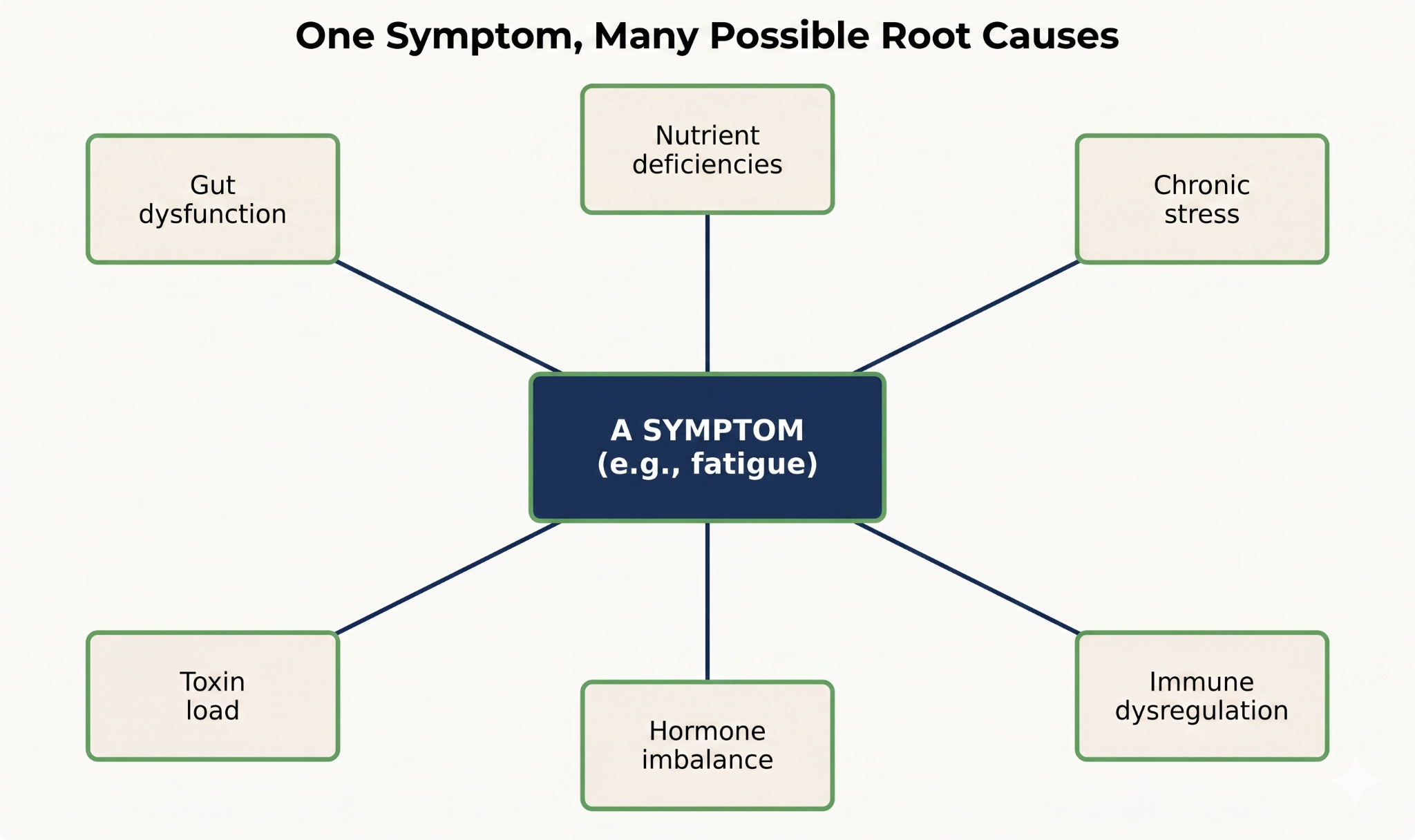
Below is the working list. These are the symptoms that bring most patients to our consultation room. They are grouped by the body system they tend to come from, although in real life one root cause often drives symptoms in multiple categories at once. That overlap is exactly why a system-wide functional medicine workup tends to clarify things that single-specialist visits cannot.
Energy is downstream of mitochondria, thyroid output, adrenals, blood sugar regulation, sleep quality, and gut absorption. When energy is off, more than one system is usually involved.
Thyroid symptoms are one of the most consistently underdiagnosed patterns in conventional care. The standard panel often stops at TSH, when Free T3, Free T4, Reverse T3, and thyroid antibodies are usually what reveal the actual problem.
Hormones never act alone. Estrogen, progesterone, testosterone, cortisol, insulin, and thyroid all feed back into each other. A symptom that looks "hormonal" often traces back to gut health, blood sugar, or stress before it even gets to the ovaries or testes.
The gut is upstream of almost everything else. When it is inflamed or imbalanced, symptoms can show up far from the abdomen, in the skin, the joints, the brain, and the immune system.
Most of the symptom clusters above only sort themselves out when the testing is wide enough to see the whole system. Integrative Wellness Centers offers in-person care across Michigan and Zoom consultations for patients in most US states. If you are ready to stop guessing and start getting answers, you can book a consultation with our functional medicine team.
Brain symptoms are rarely just a "brain problem." Inflammation, blood sugar, gut health, thyroid output, and chronic stress patterns all show up between the ears first.
Autoimmune conditions are surging, and the lag between first symptoms and formal diagnosis is often years. A functional medicine workup looks at the immune triggers (gut barrier integrity, infections, toxin load, food drivers) rather than waiting for the antibodies to climb high enough for a label.
The skin reflects gut health, hormone balance, immune activity, and detoxification capacity. When the inside calms down, the outside almost always follows.
These symptoms are often early signs of insulin resistance long before fasting glucose drifts out of range.
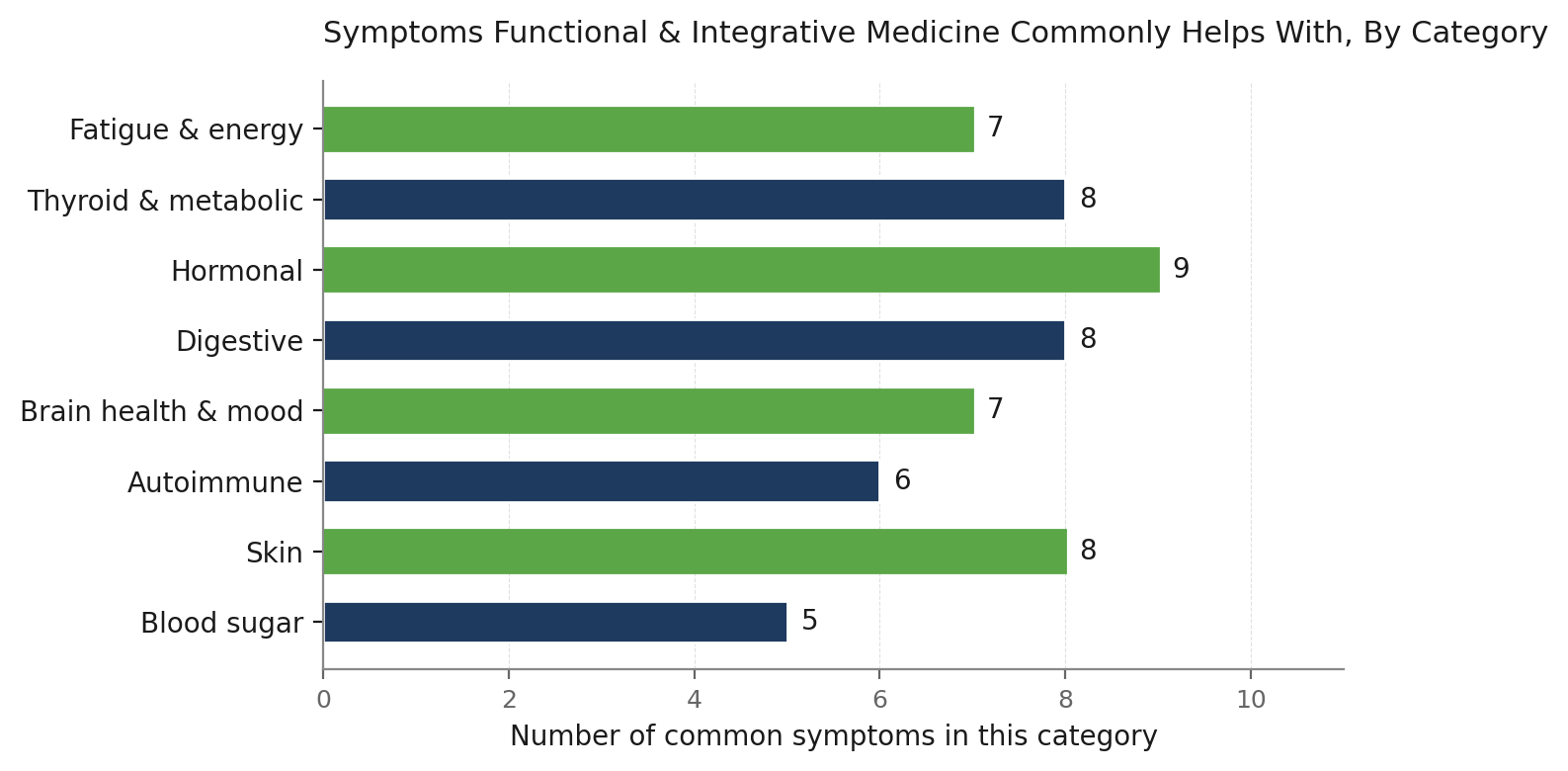
The core difference between a conventional visit and an integrative visit is what gets investigated. Instead of looking at one symptom in isolation, the visit reviews the whole timeline of how a person got here. Then advanced labs check the systems that are usually under-tested in conventional care.
A typical integrative workup goes beyond TSH and a basic metabolic panel. It often includes a full thyroid panel (TSH, Free T3, Free T4, Reverse T3, TPO and Tg antibodies), advanced markers for blood sugar regulation, nutrient status (vitamin D, B12, ferritin, magnesium RBC), inflammatory markers, and full lipid subfractions. Specialty testing may include the GI-MAP stool analysis for gut function, DUTCH hormone testing for sex and adrenal hormones, SIBO breath testing, food sensitivity panels, mold and mycotoxin testing, and nutritional testing. This is where advanced lab testing gives a much wider view of what is happening than a single-doctor referral path can.
Two patients with the same symptom rarely have the same root cause. One person's brain fog is gut-driven. Another's is blood sugar driven. A third has both, with thyroid antibodies layered on top. A real care plan addresses the actual drivers for the individual, not a one-size protocol. It typically includes a food plan tailored to the findings, targeted supplementation, lifestyle adjustments for sleep and stress, and a clear sequence over a 4 to 7 month care plan.
Nutrition is the foundation, not an afterthought. Stress regulation, sleep architecture, light exposure, movement, and detoxification capacity all show up in the labs and in the symptom picture. Ongoing monitoring across the care plan is what makes the difference between "I felt better for three weeks" and a stable, durable shift in how a person feels. The Institute for Functional Medicine framework formalizes this approach and is the clinical model used at academic centers and root-cause clinics alike.
The contrast below is the cleanest summary patients tell us they wish they had seen years earlier.
Healing from chronic symptoms is not flipping a switch. The body is designed to be self-healing and self-regulating when given the right support, and that work takes time. Most patients in a root-cause care plan begin to feel meaningful changes within the first 6 to 10 weeks. Sleep often improves first, then digestion, then energy, and finally weight, skin, hormones, and mood as the underlying systems stabilize. The 4 to 7 month frame matters because that is how long the body needs to rebuild gut lining, replenish nutrient stores, reset cortisol patterns, and bring inflammation down to a level where it stops driving symptoms.
It also matters that progress is rarely linear. Symptoms can shift, fade, and briefly return as the body works through layers. That is why ongoing monitoring and a clinical team that knows your specific picture is so important. Most patients describe the moment they stop feeling like they have a list of unrelated problems and start feeling like one connected human again. That is the goal.
For deeper context on how integrative medicine works in practice, see our integrative medicine page or our what is functional medicine page for a fuller explanation of the model.
Functional medicine and integrative medicine treat the chronic, multi-symptom patterns that conventional 15-minute visits and standard lab panels often miss, including fatigue, thyroid, hormonal, digestive, brain, autoimmune, skin, and blood sugar symptoms. By using a wider lens, optimal lab ranges, and a personalized 4 to 7 month care plan, an integrative doctor addresses the root drivers behind the symptoms rather than chasing each one in isolation.
These are the questions patients send in most often before booking a consultation. Short answers below, deeper answers throughout the article above.
1. What does functional medicine treat?
Functional medicine treats chronic, root-cause-driven symptoms across systems, including fatigue, thyroid issues, hormonal imbalance, digestive issues, brain and mood symptoms, autoimmune patterns, skin conditions, and blood sugar problems. It is built for cases where standard care has not resolved the issue or where labs keep coming back "normal" while the patient still feels unwell.
2. What is the difference between functional medicine and integrative medicine?
In day-to-day clinical practice the terms overlap heavily. Functional medicine emphasizes the systems-biology framework and root-cause workup. Integrative medicine emphasizes combining evidence-based conventional tools with evidence-informed complementary tools (nutrition, botanicals, mind-body work). Most root-cause clinics, including Integrative Wellness Centers, use both.
3. Can an integrative doctor replace my primary care doctor?
An integrative doctor typically works alongside a primary care provider rather than replacing them. The integrative team handles the deep root-cause investigation and the long-term care plan. The primary care doctor still manages acute issues, prescriptions outside the integrative scope, and routine screening.
4. Is functional medicine evidence-based?
The framework is evidence-informed and the underlying science (gut barrier function, HPA axis, nutrient biochemistry, autoimmune triggers) is well documented in mainstream medical literature. Outcome research on the model is growing, including peer-reviewed work from academic centers like Cleveland Clinic showing meaningful patient-reported improvements for chronic conditions.
5. How long does it take to feel better with functional medicine?
Most patients in a structured care plan notice meaningful change within the first 6 to 10 weeks, with the full picture stabilizing over a 4 to 7 month plan. Timelines vary by how long symptoms have been present, how many systems are involved, and how consistently the plan is followed.
6. Does insurance cover functional medicine?
Most root-cause practices, including ours, operate outside standard insurance billing so that testing and time per visit are not restricted by insurance company rules. HSA and FSA accounts typically cover services, and payment plans are commonly available. The trade-off is freedom in the clinical investigation, which is what makes the model work.
7. Do I have to live in Michigan to work with Integrative Wellness Centers?
No. Integrative Wellness Centers offers in-person care in Michigan and Zoom consultations in most US states. Telehealth is currently not available in Hawaii, Alaska, New York, Rhode Island, or New Jersey, and international service is not offered.
If this list resonated with what you have been going through, the next step is finding out whether a functional or integrative medicine approach is the right fit for your situation. Integrative Wellness Centers has supported thousands of patients since 2012, in-person across Michigan and via Zoom in most US states. You can request a new patient consultation to start the conversation with our care team.
Medical Disclaimer:
This article is for informational and educational purposes only. It is not intended as medical advice and should not replace consultation with a qualified healthcare provider. Integrative Wellness Centers makes no claims to diagnose, treat, cure, or prevent any disease. Always consult your doctor before making changes to your health regimen or discontinuing any medication.

Take the online digestive evaluation to instantly discover what systems of your body are the cause of your health issues.
Online Digestive EvaluationTake the TestOnline Female Hormone EvaluationOnline Male Hormone Evaluation


