
Discover the root causes behind low testosterone symptoms in men that standard testing misses. Learn how functional medicine finds what's really driving low T
If you've been feeling drained, foggy, irritable, or less like yourself, and a routine blood panel came back "normal," you are not alone. Millions of men living with low testosterone symptoms never get a clear answer because conventional medicine often checks only the most basic marker and calls it a day. Fatigue gets chalked up to stress. Low libido gets attributed to age. Muscle loss, mood shifts, and brain fog get dismissed or medicated around, never investigated at their source. The result is that men continue to feel terrible while being told their labs are fine.
This article breaks down what low testosterone symptoms in men actually look like beyond the surface level, and more importantly, why so many cases of low testosterone go undetected and untreated by standard medical approaches. You will also learn what a functional and integrative medicine workup looks for, and why identifying the root cause matters far more than simply replacing the hormone. Integrative Wellness Centers has worked with patients across Michigan and beyond since 2012, using advanced lab testing and personalized care plans to get to the bottom of hormonal concerns that conventional care keeps missing.
If you have been told your testosterone is "normal" but you still feel like something is off, that frustration is valid and it deserves a real investigation. Integrative Wellness Centers works with patients in-person across Michigan and via Zoom in most US states to identify what is actually driving low testosterone symptoms. You can schedule a new patient consultation to discuss your specific situation with our care team.
Testosterone is not just the hormone behind libido and muscle mass. It plays a central role in energy production, cognitive function, bone density, cardiovascular health, and emotional regulation. When levels fall below what is optimal for a given man, the ripple effects touch virtually every system in the body.
What makes this particularly urgent is that testosterone deficiency is far more common than most men realize. Research published by the Cleveland Clinic estimates that upward of 40 percent of men aged 45 and older may have testosterone deficiency, yet the majority are never tested or properly evaluated. And it is not just older men. Functional medicine clinicians are increasingly seeing low testosterone patterns in men in their 30s, driven by lifestyle, dietary, and environmental factors that conventional medicine rarely investigates.
Leaving low testosterone unaddressed is not just a quality-of-life issue. Over time, clinically low testosterone is associated with increased risk of metabolic syndrome, insulin resistance, cardiovascular disease, osteoporosis, and depression. The stakes are high, which makes understanding the real drivers behind the condition all the more important.
Low testosterone, clinically referred to as male hypogonadism, occurs when the testicles do not produce sufficient amounts of testosterone. According to the Cleveland Clinic, healthcare providers typically define low testosterone as levels below 300 nanograms per deciliter (ng/dL) in adult men, though many men experience significant symptoms well above that threshold depending on their individual baseline and how the hormone is being used at the cellular level.
The symptoms of low testosterone in men span physical, mental, and emotional domains. They tend to develop gradually, which is part of why so many men normalize them rather than connecting them to a hormone issue. Common low testosterone symptoms include:
What makes low testosterone particularly difficult to identify through standard care is that many of these symptoms overlap with other conditions, including thyroid dysfunction, adrenal fatigue, depression, sleep apnea, and nutrient deficiencies. Without comprehensive testing that looks at the full hormonal picture, providers often chase individual symptoms rather than uncovering the central driver.
The most important factor that causes low testosterone to go undiagnosed is the gap between what is considered "normal" on a standard lab reference range and what is actually optimal for health and wellbeing. A man with a testosterone level of 310 ng/dL will often be told his results are fine because his number technically falls within the broad reference range. But a 310 ng/dL reading in a man who once functioned optimally at 700 ng/dL represents a significant physiological drop, one that can produce all the symptoms described above.
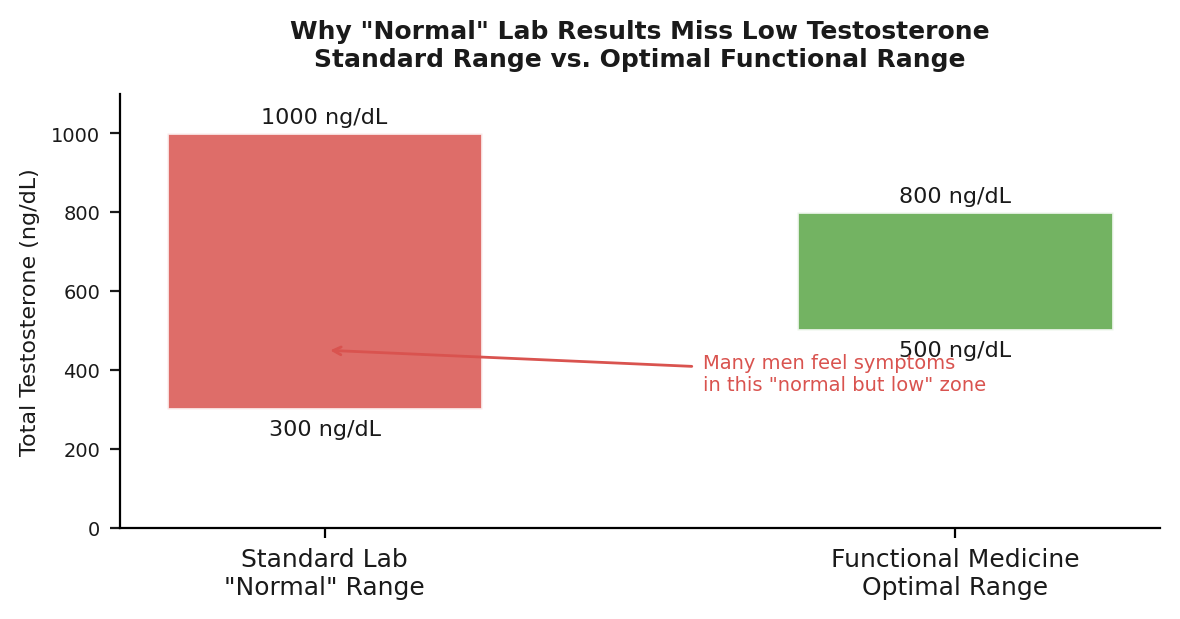
A review published in the National Institutes of Health (NIH) database highlights that the reference range for testosterone is derived from population averages, not from what is associated with symptom resolution or optimal metabolic health. This distinction matters enormously in clinical practice.
Standard testosterone testing also typically measures only total testosterone, which does not account for how much of that testosterone is biologically available. Free testosterone and sex hormone-binding globulin (SHBG) levels can significantly affect how the body actually uses testosterone. A man with a "normal" total testosterone but high SHBG may have very little free, usable testosterone at the cellular level, yet this is rarely investigated in a standard panel.
Additionally, conventional medicine often evaluates testosterone as a standalone number rather than in the context of other hormones, including estradiol, LH, FSH, DHEA-S, and cortisol. Each of these plays a role in the testosterone production cascade. Without examining the full picture, identifying why testosterone is low becomes nearly impossible.
Functional medicine takes the position that low testosterone is rarely a standalone problem. It is usually the downstream result of one or more physiological disruptions happening elsewhere in the body. Here are the most common root causes that a comprehensive functional workup will investigate.
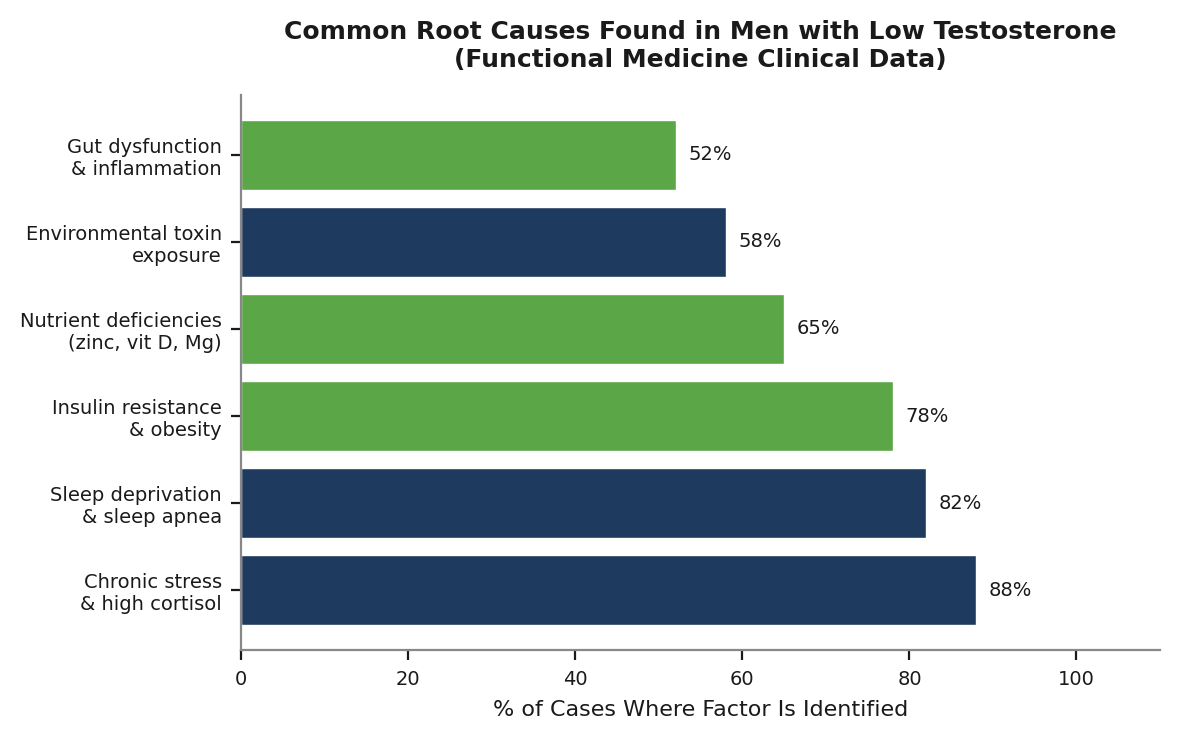
The relationship between stress hormones and testosterone is direct and well-documented. Cortisol, the body's primary stress hormone, competes with testosterone along the same biochemical pathway. When the adrenal glands are chronically producing high amounts of cortisol in response to ongoing psychological, physical, or environmental stress, testosterone production is suppressed. This is sometimes called the "cortisol steal" or pregnenolone steal, referring to the way the body prioritizes stress hormone production over sex hormone synthesis when it perceives a threat.
Men under sustained work pressure, relationship stress, or financial strain often develop this pattern without recognizing it as a hormonal issue. A comprehensive workup using tools like the DUTCH hormone test can map the full daily cortisol curve alongside sex hormone metabolites to identify this pattern with precision.
Testosterone is primarily produced during deep sleep, particularly during REM cycles. Research published in PubMed confirms that even modest sleep restriction of just a few days can measurably suppress testosterone levels, while simultaneously raising cortisol. Men who are chronically sleep-deprived, whether from lifestyle habits or undiagnosed obstructive sleep apnea (OSA), often present with all the classic low testosterone symptoms.
Sleep apnea is particularly insidious because it disrupts oxygen delivery throughout the night and activates the stress response system repeatedly, further elevating cortisol and suppressing the hypothalamic-pituitary-gonadal (HPG) axis that controls testosterone production. A significant percentage of men with undiagnosed sleep apnea have clinically low testosterone, yet the sleep apnea itself is never investigated when a man comes in complaining of fatigue, low libido, or mood changes.
Insulin resistance and excess body fat, particularly visceral fat around the abdomen, have a bidirectional and damaging relationship with testosterone. Visceral fat tissue contains an enzyme called aromatase that converts testosterone into estradiol. The more visceral fat a man carries, the more testosterone is being converted to estrogen, creating a cycle where low testosterone leads to fat gain, which leads to even lower testosterone.
Additionally, insulin resistance directly impairs testicular function and reduces the production of luteinizing hormone (LH), the pituitary signal that tells the testes to produce testosterone. Addressing insulin resistance through dietary and lifestyle changes is often one of the most effective ways to support testosterone production naturally, yet it is rarely the primary focus in a conventional visit.
Testosterone synthesis requires specific raw materials, and deficiencies in certain nutrients directly impair the body's ability to produce it. The three most clinically relevant are:
Standard blood panels do not always catch functional deficiencies. Nutritional testing through advanced panels like the Organic Acids Test (OATS) or Nutreval can identify intracellular nutrient status that a basic serum level would miss.
Endocrine-disrupting chemicals (EDCs) found in plastics, pesticides, personal care products, and industrial pollutants can interfere with testosterone production and signaling. Compounds like BPA (bisphenol A), phthalates, and certain pesticides mimic or block hormonal signals at the cellular level. Chronic low-level exposure, which is nearly unavoidable in modern life, contributes to the broader trend of declining testosterone levels observed across populations over recent decades.
Mold toxin exposure, which can come from living or working in water-damaged buildings, also poses a significant and frequently overlooked hormonal threat. Mycotoxins have been shown to disrupt the HPG axis and suppress testosterone production. Functional medicine practices that offer mold and mycotoxin testing through providers like Great Plains Laboratory can identify this root cause when it is present.
The gut microbiome plays a more significant role in hormonal health than most people realize. An imbalanced gut microbiome (dysbiosis), leaky gut (intestinal permeability), or chronic gut infections can drive systemic inflammation, and chronic inflammation is one of the most potent suppressors of the HPG axis. Inflammatory cytokines directly inhibit the pituitary gland's ability to release LH and FSH, the hormones that drive testosterone production.
Additionally, certain gut bacteria are responsible for metabolizing and recycling estrogen through a process involving an enzyme called beta-glucuronidase. When dysbiosis allows beta-glucuronidase activity to become elevated, reabsorption of estrogen increases, further disrupting the testosterone-to-estrogen ratio in men. GI-MAP stool testing can evaluate the microbiome, identify dysbiosis, check for opportunistic infections, and assess intestinal permeability markers.
Understanding what is actually driving your low testosterone symptoms starts with testing that goes far deeper than a single number. Integrative Wellness Centers offers in-person care throughout Michigan and Zoom consultations for patients across most US states. If you are ready to stop guessing and start getting real answers, book a consultation with our functional medicine team and let us build a full picture of what is happening.
Rather than starting with hormone replacement and working backward, a functional medicine evaluation for low testosterone in men begins with a comprehensive assessment of every system that influences hormone production and metabolism. This is what separates a root-cause approach from symptom management.
Integrative Wellness Centers uses a multi-step process that includes an in-depth intake reviewing health history, lifestyle, and symptom patterns, followed by targeted advanced testing ordered based on each patient's individual presentation.
A thorough functional evaluation of low testosterone symptoms typically includes:
You can learn more about the advanced lab testing approach used at
Integrative Wellness Centers through their advanced lab testing page, which outlines the full range of diagnostic tools available.
Once the results are in, each patient receives a care plan that is specific to their findings rather than a generic protocol. For one man, the primary driver might be unresolved sleep apnea and elevated cortisol. For another, it might be insulin resistance combined with zinc and vitamin D deficiency. For a third, it could be gut-driven inflammation suppressing the HPG axis.
Treatment strategies may include targeted nutritional and botanical support to restore testosterone-related pathways, dietary changes to address insulin resistance or support gut health, sleep optimization protocols, stress reduction and nervous system support, environmental detoxification strategies, and when clinically appropriate, bioidentical hormone support with careful monitoring.
The goal is to restore the conditions the body needs to produce and use testosterone effectively on its own, rather than immediately bypassing those systems with exogenous hormones.
Hormonal recovery is not linear and it takes time. Most patients working on testosterone-related concerns through a functional medicine program see meaningful change over a four to seven month care plan, with regular lab reviews and visits to assess progress and refine the approach. Ongoing monitoring of a comprehensive hormone and metabolic panel ensures that the response to treatment is tracked carefully and adjusted as needed.
For more background on what the functional medicine process looks like at Integrative Wellness Centers, you can visit the
practice's hormonal imbalance page, which covers how hormonal concerns are approached as part of a broader systemic evaluation.
Recovery from low testosterone is not about hitting a number on a lab report. It is about feeling like yourself again: having energy to get through the day, thinking clearly, maintaining your body composition without extraordinary effort, and engaging with your relationships and work with presence and drive.
Patients often describe the experience of addressing root-cause-driven low testosterone as a gradual but meaningful shift. The first changes are often improvements in sleep quality and energy levels, usually within the first four to eight weeks of working on the underlying drivers. Mood stability and cognitive clarity tend to follow. Libido and body composition improvements often become noticeable over the three to six month range.
It is important to understand that the timeline for recovery depends heavily on how many root causes are present and how long they have been active. A man in his late 30s with lifestyle-driven low testosterone who has been dealing with it for two years will typically respond faster than a man in his 50s with multiple overlapping drivers. Setting realistic expectations and working with a care team that monitors progress closely is essential.
What remains consistent across cases is that identifying and addressing root causes, rather than simply adding testosterone from the outside, tends to produce more stable, sustainable outcomes. The body, when given the right support, is remarkably capable of restoring its own hormonal function.
Low testosterone symptoms in men are widely underdiagnosed because standard testing measures only total testosterone against a broad population range, missing the functional, root-cause picture entirely. The real drivers behind low testosterone often include chronic stress, poor sleep or sleep apnea, insulin resistance, nutrient deficiencies, environmental toxin exposure, and gut-driven inflammation, none of which are evaluated in a routine blood panel. A functional medicine workup that examines the full hormonal and metabolic landscape can identify what is actually causing the problem and create a care plan that addresses it at the source.
If you have been searching for answers for low testosterone and feel like conventional approaches have not gotten to the root cause, you are not alone. Integrative Wellness Centers works with patients in person across Michigan and via Zoom in most US states to identify what is actually driving these sleep issues. You can schedule a new patient consultation to discuss your specific situation with our care team.
Below are some of the most frequently asked questions from men researching low testosterone symptoms, causes, and what to do about them.
The most reported low testosterone symptoms in men include persistent fatigue, reduced sex drive, difficulty building or maintaining muscle, increased belly fat, brain fog, depressed mood, and poor sleep. These symptoms tend to develop gradually, which is why many men normalize them and do not connect them to a hormonal issue until years have passed.
In younger men, low testosterone is most commonly driven by lifestyle and environmental factors rather than age-related decline. Chronic stress and high cortisol, poor sleep quality or sleep apnea, insulin resistance from a high-sugar diet, nutrient deficiencies (particularly zinc and vitamin D), and exposure to endocrine-disrupting chemicals in plastics and pesticides are among the most frequently identified root causes in men under 40.
Yes. Research has consistently linked low testosterone with depressed mood, emotional flatness, irritability, and reduced motivation. Testosterone plays a direct role in neurotransmitter regulation, including dopamine and serotonin pathways. When levels are low, mood stability is often one of the first areas to be affected. Men who are treated for depression without investigating testosterone levels may not respond well to antidepressant medications because the hormonal root of the mood issue is not being addressed.
Standard testing involves a morning total testosterone blood draw. While this is a starting point, it misses free testosterone, SHBG, estradiol, LH, FSH, cortisol, and thyroid markers, all of which are necessary to understand the full hormonal picture. A functional medicine evaluation uses a broader panel and often includes the DUTCH hormone test for a detailed map of how sex and stress hormones are being produced and metabolized throughout the day.
Testosterone does decline naturally with age, typically around 1 percent per year after age 30. However, normal age-related decline is gradual and mild. Men who experience significant fatigue, cognitive decline, muscle loss, mood changes, and loss of libido in their 30s or 40s are usually dealing with accelerated decline driven by identifiable root causes, not simply aging. A comprehensive workup can determine whether the pattern is physiological aging or something more correctable.
In many cases, yes. When low testosterone is being driven by modifiable root causes such as sleep apnea, insulin resistance, nutrient deficiencies, or chronic stress, addressing those underlying factors can meaningfully improve testosterone levels without exogenous hormone therapy. The degree of improvement depends on the severity of the deficiency and how many root causes are present. Functional medicine evaluates this on an individual basis before recommending any specific intervention.
The timeline varies based on the number and severity of root causes, how long they have been present, and how quickly the body responds to targeted support. Many patients notice improvements in sleep quality and energy within the first four to eight weeks. More significant changes in body composition, libido, and cognitive function typically appear over three to six months. Full hormonal optimization through a root-cause program usually unfolds over a four to seven month care plan.
If the symptoms described in this article match what you have been experiencing, the next step is finding out what is actually behind them. Integrative Wellness Centers has supported patients across Michigan and throughout the US via Zoom since 2012, using a testing-not-guessing approach to hormonal concerns. Request a new patient consultation to start the conversation with our functional medicine care team and get a clear picture of what your hormones are actually doing.
Medical Disclaimer: This article is for informational and educational purposes only. It is not intended as medical advice and should not replace consultation with a qualified healthcare provider. Integrative Wellness Centers makes no claims to diagnose, treat, cure, or prevent any disease. Always consult your doctor before making changes to your health regimen or discontinuing any medication.

Take the online digestive evaluation to instantly discover what systems of your body are the cause of your health issues.
Online Digestive EvaluationTake the TestOnline Female Hormone EvaluationOnline Male Hormone Evaluation


